Bacteriostatic Water in Laboratory Peptide Reconstitution: Stability, Osmolarity & Sterile Preservation
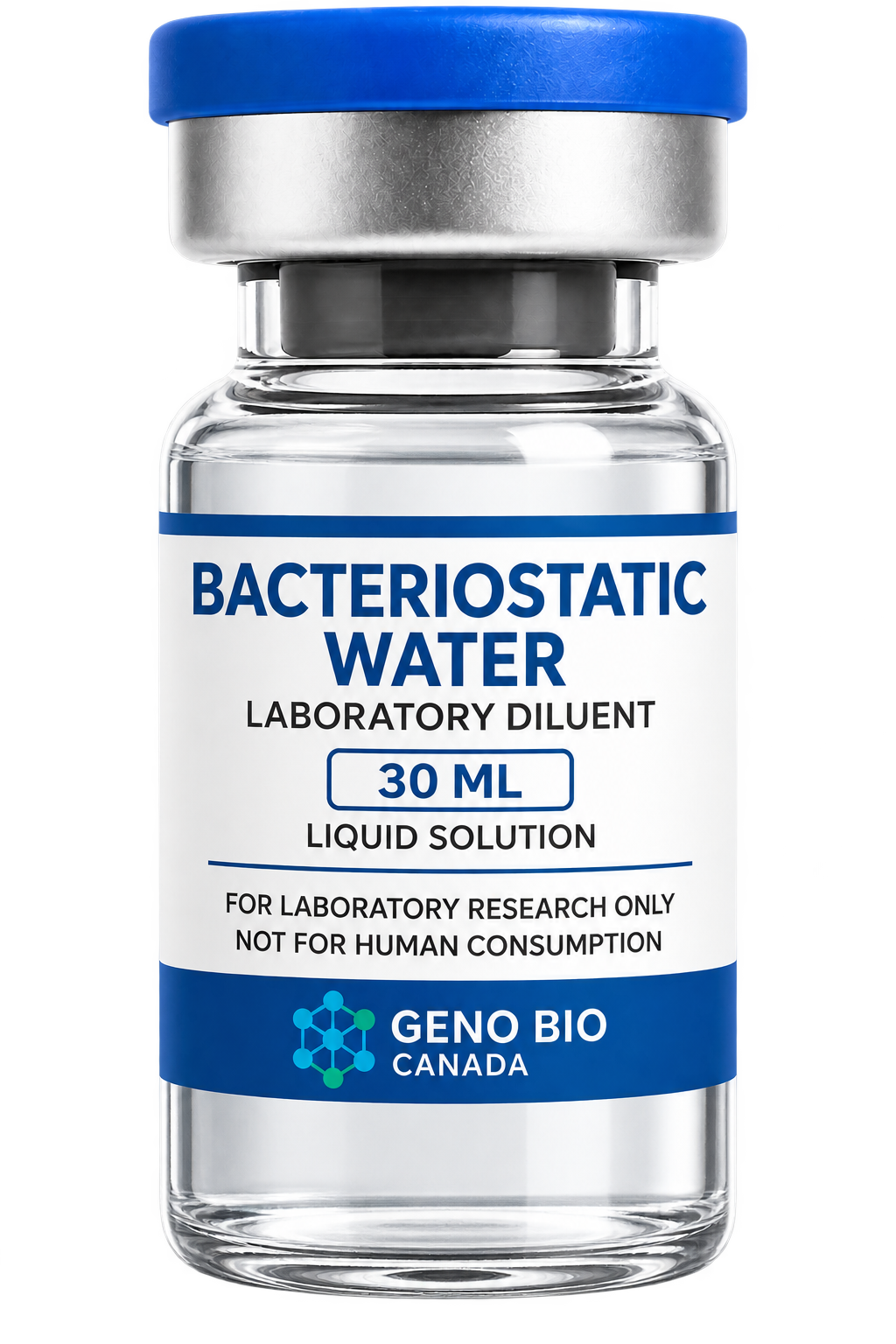
“Bacteriostatic Water for Injection (USP) containing 0.9% (9 mg/mL) benzyl alcohol serves as the standardized sterile reconstitution diluent for lyophilized research peptides, preventing microbial proliferation and preserving peptide secondary structure in multi-dose laboratory protocols.”
Legal & Laboratory Compliance Notice
FOR IN-VITRO LABORATORY RESEARCH ONLY: This scientific publication is provided strictly for academic and biochemical reference by certified researchers. Materials and compounds referenced are NOT for human consumption, veterinary use, drug manufacture, or direct clinical administration. Statements have not been evaluated by Health Canada or the FDA.
Scientific Research Overview
Abstract & Executive Summary
Lyophilization (freeze-drying) is the industry standard method for stabilizing synthesized peptides, removing water sublimation under vacuum to yield a stable, dehydrated peptide cake. However, to utilize these compounds in analytical bioassays, cell culture experiments, or animal models, they must be reconstituted into a sterile, biologically compatible aqueous phase.
Bacteriostatic Water for Injection (USP) is a sterile, non-pyrogenic preparation of purified water containing 0.9% (w/v, 9 mg/mL) benzyl alcohol (C7H8O) added as an antimicrobial bacteriostatic preservative.
While standard Sterile Water for Injection (SWFI) contains zero preservatives and must be used immediately and discarded after a single vial entry (due to rapid bacterial proliferation from atmospheric airborne spores within 24-48 hours), Bacteriostatic Water actively inhibits microbial growth, enabling repeated sterile needle entries into multi-dose laboratory vials for up to 28 days under refrigeration (2°C to 8°C).
+----------------------------------------------------------------------------------------------------+
|                                    RECONSTITUTION MEDIUM COMPARISON                                |
+------------------------------------+----------------------------------+-----------------------------+
| Feature                            | Bacteriostatic Water (0.9% BA)   | Plain Sterile Water (SWFI)  |
+------------------------------------+----------------------------------+-----------------------------+
| Preservative Agent                 | 0.9% Pharmaceutical Benzyl Alcohol| None                        |
| Multi-Entry Stability              | **Up to 28 Days** (2°C - 8°C)    | **Single Entry Only**       |
| Bacterial Proliferation Risk       | Completely Inhibited             | High (within 24-48 hours)   |
| Endotoxin Threshold                | Strict USP <85> (<0.5 EU/mL)     | Strict USP <85> (<0.5 EU/mL)|
| pH Range                           | 4.5 - 7.0 (Buffer Compatible)    | 5.0 - 7.0                   |
+------------------------------------+----------------------------------+-----------------------------+
Chemical Specifications & Quality Parameters
Mechanism of Action
Bacteriostatic water functions as both a high-dielectric solvation medium and an antimicrobial barrier:
1. Benzyl Alcohol Microbial Membrane Permeabilization
Benzyl alcohol is an aromatic alcohol with moderate lipophilicity:
2. Peptide Solvation & Hydrogen Bond Network Formation
Water has a high dielectric constant (ε ≈ 80 at 20°C):
3. Prevention of Mechanical Shearing & Denaturation
Improper reconstitution is the primary cause of peptide loss in research settings:
4. Thermal & Freeze-Thaw Degradation Kinetics
Key Study Highlights
0.9% Benzyl Alcohol Preservative
Pharmaceutical bacteriostat inhibiting bacterial and fungal replication for up to 28 days.
USP <85> Endotoxin Tested
Guaranteed low endotoxin (<0.5 EU/mL) ensuring non-pyrogenic experimental conditions.
Multi-Entry Sterile Integrity
Maintains sterile multi-dose vial sampling without compromising compound analytical purity.
Secondary Structure Preservation
High-dielectric solvation medium maintaining native peptide alpha-helices and beta-sheets.
Scientific FAQs
References
- USP Convention (2022).Bacteriostatic Water for InjectionUSP-NF Reference Monograph
- Meyer B.K. et al (2007).Antimicrobial preservative use in parenteral formulationsJ Pharm Sci, 96(12):3155-3167
Procure Research Reference Materials
Access laboratory-grade reference compounds with verified batch HPLC purity reports and sterility documentation.
View Compound SpecificationsLiterature Inquiries
Have questions about the pre-clinical citations or chemical parameters detailed in this research? Connect with our analytical representatives.